ISSUE #08

Continuously Connected Systems

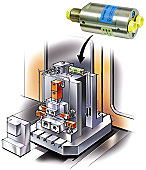
Most Enerpac workholding components are rated at 5000 psi, which allows the use of compact components that achieve high forces. In order to fully realize the benefits of these components it may be necessary to use hydraulic intensifiers to increase pressure. Hydraulic intensifiers use low pressure flow from the onboard hydraulic power supply and increase it to a pressure range more suitable for clamping components. Intensifiers are small, quiet, and can be installed in any circuit where a low pressure power supply is present.

An intensifier incorporated into a fixture.
Cross-section drawing of a typical four-passage rotary union.


In clamping applications, high pressure is required for only a small portion of a machine cycle. An intensifier starts to work only when there is a need for high pressure. The rest of the time it is passive, has no internal consumption, and thus does not influence the performance of the machine system. When oil is supplied to the intensifier, it starts to build up the required end pressure. When that pressure has been reached, the intensifier stops and operates only as needed to maintain the pressure—for example to compensate for consumption or a leak. (Internal bypass valving enables high output flow rates during the early stages of pressure buildup.) Tip: The high volume flow of a typical onboard system can increase the intensifier’s stroke rate to a level at which its life is reduced. In such systems, it is a good idea to place a flow control valve before the intensifier.

Dedicated Power Supply
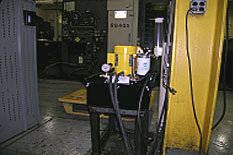
The second approach is to use a dedicated hydraulic power supply to feed the workholding system. Stand-alone units are often rated at higher pressures and lower flows than machine tool hydraulic systems. As a result they are a better match to work with standard workholding components. Separate units allow more flexibility in controlling workholding fixtures. They can be configured with various valving options and controls necessary to control workholding fixtures.

A stand-alone power unit can serve several machines.   Stand-alone units can also be used to power workholding systems on several machines at the same time. From a centrally located power unit, lines are routed to individual machines. (Floor troughs are an ideal, out-of-the-way method.) Control valves located on each machine allow the flexibility of individual control.


TM and © Enerpac 2005
All rights reserved. Reproduction of any materials without Enerpac's permission is strictly prohibited.