
Continuously Connected Systems
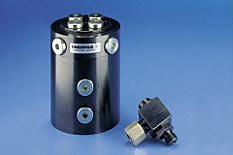
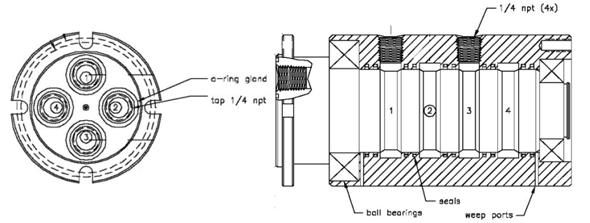
| A rotary union is a device used to transfer hydraulic fluid from a stationary device to a rotating device where typical hydraulic lines would become twisted. Enerpac offers one-, two-, and four-passage rotary unions. The internals of rotary unions are arranged in “layer cake” fashion. Oil passages enter from one end of a cylindrical central core and pass along the core interior to open into individual, circular galleries arranged like layers of a cake. The galleries are separated from each other by seals. |
 |
|
| Four- and one-passage rotary unions. | ||
 |
||
Cross-section drawing of a typical four-passage rotary union. |
||
Therefore, flow and pressure have to be considered when utilizing machining center hydraulics. These power supplies are designed to provide hydraulic pressure and flow to a wide range of components on the machining center, but are not always an ideal match to the hydraulic workholding system. Maximum flow rate requirements of some workholding components may necessitate use of flow controls. Onboard units may also be limited in valving options necessary to control workholding fixtures. Workholding circuits typically require proper sequencing of location, support and clamping cylinders to ensure correct workpiece finishes and tolerances. The circuit may also require multiple pressure settings for different components on the fixture. These valving requirements normally must be supplied in addition to the standard hydraulic power supply. |
||
|
||||
 |
 |
 |
 |
 |
TM and © Enerpac 2005
All rights reserved. Reproduction of any materials without Enerpac's permission is strictly prohibited.