|
Applications
Power workholding is particularly suited for medium to high volume applications and lends itself well to integration with automated manufacturing systems. Hydraulic workholding is particularly
|
appropriate where critical tolerances must be held. It allows clamping force to be maintained within a 1% accuracy. This type of accuracy and repeatability permits machining to tolerances as tight as ±1 mil.
|
|
|
| Parameters |
Hydraulic |
Mechanical |
| Production quantity: |
60,000 pcs
|
60,000 pcs
|
| Material cost per piece: |
25.00
|
25.00
|
| Machine time cost per hour: |
150.00
|
150.00
|
| Fixture cost: |
30,000.00
|
5000.00
|
| Parts per fixture: |
4
|
4
|
| Load + unload time: |
20 sec.
|
240 sec
|
| Run time: |
720 sec.
|
720 sec.
|
| Labor cost per hour: |
30.00
|
30.00
|
| Resulting costs, per piece |
| Material: |
25.00
|
25.00
|
| Machine time: |
8.82
|
11.43
|
| Fixture |
0.50
|
0.08
|
| Cost of fixture money at 5%: |
0.04
|
0.01
|
| Labor (one 8hr shift, 7hr working) |
1.76
|
2.28
|
|
Total cost per piece:
|
$36.12
|
$38.80
|
Compared with mechanical workholding, hydraulic workholding is a classic example of a way of doing something that costs more upfront, yet is cheaper in the long run.
Here is an illustrative cost comparison. It is offered with some trepidation, in that any of the numbers used could be critiqued. However, the important point is that if you work the numbers using other values, you will still invariably find there is a production quantity beyond which hydraulic workholding becomes the most economical option.
Using hydraulic workholding, not only is the cost lower by $2.68 per piece, the run is completed in 18 months, versus two years |
|
|
Collet-Lok® Workholding
|
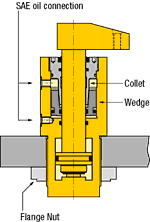 |
A unique product from Enerpac combines the benefits of hydraulic workholding with the long-term stability of bolted mechanical fixturing. The Collet-Lok® system provides the speed, precision, controllable clamping force, safety, and automation compatibility of hydraulic fixturing. But in addition, once the part is positioned, supported, and clamped, the cylinders are mechanically locked in place so that all hydraulic pressure can be removed for any length of time.
When clamping is completed and locked, the fixture can be entirely disconnected from the hydraulic system, or even if left connected, it is not dependent on the hydraulic supply to retain clamping force.
|
How is this accomplished? As seen in the cross-section, hydraulic pressure is used to drive a wedge that mechanically locks a collet chuck around the cylinder plunger. With the plunger locked, all hydraulic pressure can be removed. The collet releases the cylinder plunger only when hydraulic pressure is applied to the opposite end of the wedge. The next chapter of Enerpac University provides details of this versatile system. |
|


