In some applications, the pressure and flow of hydraulic oil required to operate various cylinders can be derived from a machine’s hydraulic system. In all other cases, a type of pump or power source must be included in the design.
Hand Operated
The most rudimentary power source is the hand-operated pump. While they are a low-cost power source, hand pumps are of limited usefulness because they are slow. Additionally, they can only operate single-acting cylinders. Therefore, hand pumps are best reserved for occasional special situations.
Air Operated
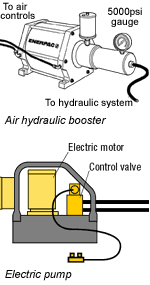
The air hydraulic booster is a simple source of one-shot hydraulic power. Here, a large-diameter air cylinder drives a smaller diameter hydraulic cylinder, providing 5000 psi hydraulic pressure from shop air pressure. These devices can provide high oil pressures and flow rates, but are limited by their nature as to the amount of oil that can be continuously delivered.
|
The air-operated hydraulic pump is the next step in sophistication. These products range from compact "portable" units that can be mounted directly on a fixture to free-standing units that include reservoirs and modular control valve mounts. Portable pumps are best suited to single-acting cylinders, while free-standing units can handle single- or double-acting cylinders on small to medium-size fixtures.
Electric Operated
The electric motor-driven hydraulic pump, although the highest price source, provides the greatest flexibility and capacity. Desired pressure and flow dictate the required source horsepower, and for larger setups an electric pump may be the only suitable source.
Advantages of electric pumps include high delivery for high speed operation; modular design for easy attachment of manifolds,
filters, heat exchangers, and controls; and compatibility with automation systems. |
 |
| Typical Components - System Components |
Cylinders, pumps, and valves are the primary workholding components, but the "little things" count too. For example, pressure gauges are your "window" to the hydraulic system, revealing the status of various parts of the hydraulic circuit.
The accumulator is another helpful device. It is a chamber, divided by a sturdy diaphragm. On one side of the diaphragm is a charge of high-pressure gas. The other side of the diaphragm chamber is connected to the hydraulic circuit.
In operation, the chamber and pressurized diaphragm absorb pressure pulsations and thermal expansion of the hydraulic oil, and provide a small but "instantly" available reserve supply of oil.
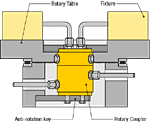
Rotary couplers (rotary unions) are unions specially designed to transfer pressurized hydraulic oil from a stationary supply line to a rotating device such as a rotating index table.
|
Pressure switches, available in both mechanically operated and all-electronic versions, serve to monitor hydraulic pressure. The switch outputs can be used for status indication, safety purposes, or automation interfacing.
Filtering is a must! Contaminated hydraulic oil is the number one cause of failures. Filters can be installed in the high pressure line, return line, or both.
Fluid lines can be of steel tubing or hose. Care should be taken to use only the specified tubing, hose, and fittings in order to assure reliable and safe operation.
Hydraulic oil, the lifeblood of the workholding system, shouldn’t be taken for granted. A manufacturer-specified oil has controlled characteristics, such as viscosity, flash point, and pour point. |
 |
|


