
Typical Components – Valves
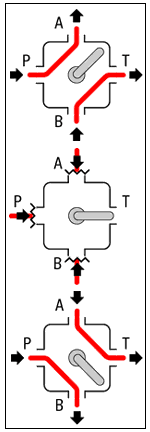 Directional Valves control flow of oil to different parts of the circuit. |
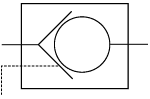
Valves are the fundamental control devices. There are many kinds of valves, but any given valve serves to determine the flow path, flow rate, or pressure of the hydraulic oil. Enerpac valves are of modular design, which simplify system assembly. Directional Control Valves They are just what the name implies, multiport valves used to direct hydraulic oil. Single-acting cylinders are usually operated by 3-way valves, while double-acting cylinders are operated by 4-way valves. Sequence Valves Directional control valves that control the order of operation of various branches of the hydraulic circuit are sequence valves These valves are activated by a sensed pressure. When one part of the hydraulic circuit reaches a preset pressure, the sequence valve opens to permit oil to flow to another part of the circuit. An example is activation of a support cylinder first, then the corresponding clamping cylinder. The sequence valve contains a check valve in parallel with the directional valve mechanism. The result is sequenced/directed flow in one direction (toward the loads, during clamping) and unrestricted flow in the other direction (unclamping). Check Valves Check valves are used to allow the flow of hydraulic oil in only one direction. A special version, the pilot operated check valve, is used to hold pressure in one part of a circuit and release the pressure upon command. A pilot operated check valve works the same as a regular check valve, but also has an additional port. The application of a low pressure (about 15% of working pressure) to this extra port causes the check valve to permit oil flow in both directions, releasing the contained pressure. |
Flow Control Valves Flow control valves control the operating speed of hydraulic components by means of an adjustable orifice. They also contain a check valve in parallel with the metering orifice. The result is restricted flow in one direction (toward the load) and unrestricted flow in the other direction (return). The most common use of flow control valves is to regulate the operating speed of cylinders. When the holding pressure on a cylinder is released, a spring in the cylinder produces a small pressure, causing the check valve to open and thereby providing rapid cylinder release. Pressure Reducing Valves Pressure reducing valves do just that; they are adjustable pressure regulators, used to provide reduced oil pressure to a secondary part of the circuit. A common use is to control the clamping force of a cylinder. NOTE: Pressure Limiting Valves perform a more specialized function. They deliver a settable lower pressure to a secondary part of the circuit. However, when the set pressure is reached they do not supply any makeup oil to maintain that set pressure. Pressure relief valves Pressure relief valves limit the maximum pressure in the hydraulic circuit. For safety, all hydraulic systems should include a relief valve. An Enerpac relief valve does not act instantly. As pressure approaches the set point, the valve permits a very small amount of oil to pass before further pressure rise results in full opening of the valve. Therefore, a relief valve should not be adjusted under conditions different from use. For example, don’t set the valve with a hand pump and then use it with a power pump. |
 |
|
||||
 |
 |
 |
 |
 |
TM and © Enerpac 2002
All rights reserved. Reproduction of any materials without Enerpac’s permission is strictly prohibited.