
Hydraulic Workholding
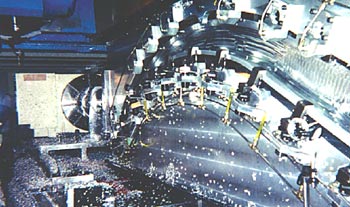
The term power workholding refers to the use of pneumatic or hydraulic systems to perform the supporting, positioning, and clamping functions necessary to machine a part. This discussion focuses on hydraulic workholding, which has more capabilities and versatility than pneumatic.
The three fundamental types of components used in hydraulic workholding are cylinders, pumps, and valves. As detailed in the first chapter, cylinders convert the flow and pressure of hydraulic oil to linear motion and force. Pumps convert power from compressed air or electricity to hydraulic power: pressure to provide clamping force and flow to move cylinders. Valves are used to control the flow path, flow rate, or pressure of hydraulic oil.
Advantages
In order to be productive and efficient, procedures such as positioning, supporting, clamping, and release must be rapid, straightforward, and safe. This is especially true for larger parts with relatively brief processing intervals, making semi-automatic or fully automatic clamping in one fixture a profitable option. Hydraulic workholding is an extremely reliable and efficient way to accomplish these objectives.
These are the principal advantages of hydraulic workholding:
| 1. | Time gain – The major benefit of hydraulic workholding is the enormous time saved in clamping and unclamping. Time reductions of 90 to 95% are not unusual. Less machine idle time means more capacity utilization and lower costs. | 3. | Less fixture space – Compact standard components and the ability to clamp in manually inaccessible areas allow optimum use of fixture space. Often, more parts can be clamped and processed simultaneously on one fixture. |
| 2. | Accuracy and repeatability – Consistent clamping forces produce precise, repeatable locating and identical processing of each part. Virtually no parts are rejected due to distortion. |
4. | Safety – Less operator interaction means less chance of mishaps. |
| 5. | Automation – Automating part of the production process frees operators for other tasks. |
||
 |
|||
|
||||
 |
 |
 |
 |
 |
TM and © Enerpac 2002
All rights reserved. Reproduction of any materials without Enerpac’s permission is strictly prohibited.